
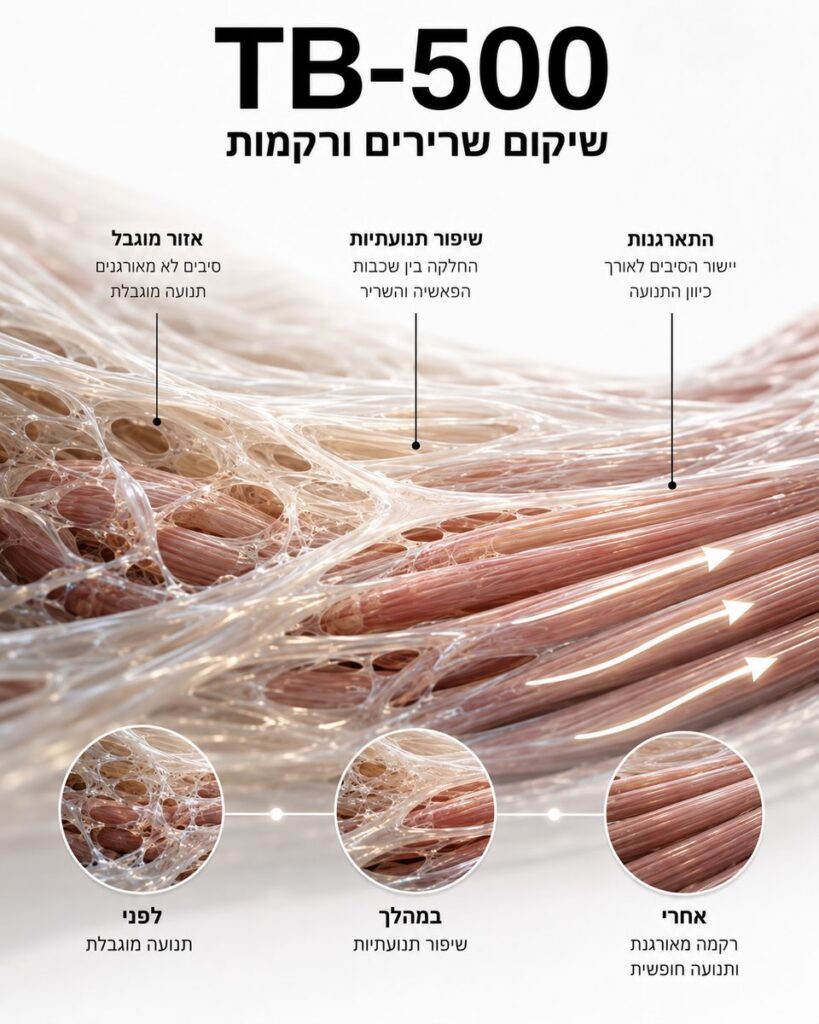
TB-500 is a peptide well known in the research world on recovery and tissue elasticity, and is often mentioned alongside BPC-157. We'll explain what it is and what the research examines.
The information in this article is for educational purposes only and does not constitute medical advice. All products on the site are for research use only.
What is TB-500?
TB-500 is a synthetic version of an active fragment from a protein called Thymosin Beta-4 (TB4), which is found naturally in many tissues in the body. In research it has been examined in the context of tissue repair, elasticity, and cell motility.
What does the research examine?
Pre-clinical studies have examined TB-500 in the contexts of tissue healing, formation of new blood vessels (angiogenesis), and elasticity. It is considered more "systemic" in nature compared to region-targeted peptides. Like many in the field, this is early-stage research and the compound is not approved for use in humans.
Why is it studied alongside BPC-157?
Both peptides are studied in the context of recovery, but through complementary mechanisms — which is why many researchers examine them together. We detailed the precise differences inthe comparison article.
Frequently asked questions
TB-500 and TB4 — the same thing?
TB-500 is a synthetic fragment/version related to Thymosin Beta-4, not the full protein.
How is it reconstituted?
From freeze-dried powder, using bacteriostatic water; for the calculation see the our dilution calculator.
For the research product details: TB-500. See also What is BPC-157 and The general guide.
How do you tell whether a peptide supplier in Israel is reliable? All the signs are in our selection guide.
The information is general and for educational purposes only and does not constitute medical advice. The products are for research use only.