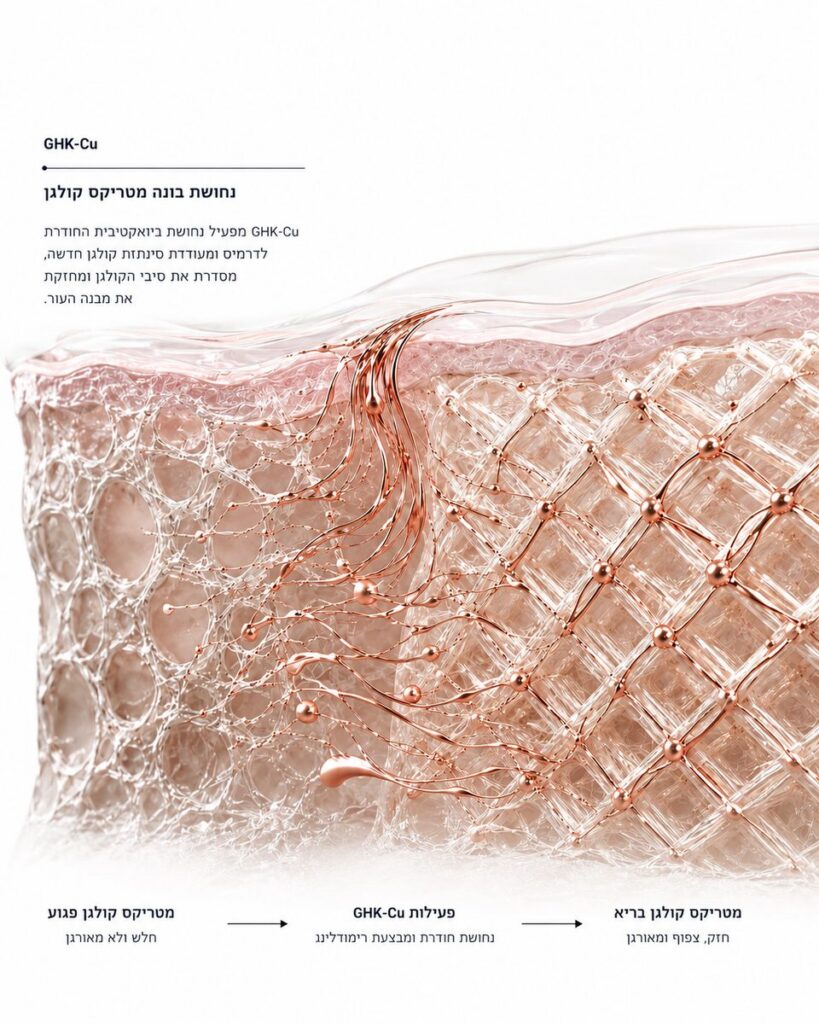
GHK-Cu — the copper peptide — is one of the most-studied in the context of skin, collagen, and tissue regeneration. We'll explain what it is and what the research examines.
The information in this article is for educational purposes only and does not constitute medical advice. All products on the site are for research use only.
What is GHK-Cu?
GHK-Cu is a short peptide (three amino acids: glycine-histidine-lysine) bound to a copper ion. It occurs naturally in the body, and its level declines with age — a fact that has made it a focus of interest in research on regeneration and anti-aging.
What does the research examine?
Studies have examined GHK-Cu in the context of collagen production, tissue healing, and the balance of substances in skin tissue. Because of its connection to copper — an important element in many biological processes — it has also been studied in contexts of cellular "signaling".
Why is it popular in the skin field?
The combination of a small, stable peptide with copper has made it widely studied in the cosmetic-research field. That said, as always — there is a difference between laboratory findings and conclusions, and the compound is for research use only.
Frequently asked questions
Why copper specifically?
The copper is part of the molecule and of its studied activity — not an incidental addition.
How is it reconstituted?
From powder, using bacteriostatic water andour dilution calculator.
For the research product details: GHK-Cu · GLOW. For the general guide — What are peptides.
Looking for where to buy research peptides? We've compiled everything important to check before buying.
The information is general and for educational purposes only and does not constitute medical advice. The products are for research use only.